Earlier I wrote about the editing style of the 80s film as compared to 70s films. At the moment, I am considering, watching and analyzing a number of 70s films with dialogue, sequence and editing in mind and intend to do some later in depth posts about this very topic. I'd like to, with this post, compose some of these ideas to use as a reference. Curiously, this topic about dramatic pauses coincides with a period of writerly pause, if you will, and there is some drama involved. In that sometimes there are ideas, so many ideas swirling around in my head that I can't grasp any of them and so writing becomes a frustrating and even draining undertaking. That said, I'm working on the 70s items and on making The Male Appetite into a series and also have some more 80s film and actor posts in the works too. Yet, sometimes the act of writing is about thinking, gathering ideas and then hopefully managing to convey them in a way that makes sense and is entertaining.
So I suppose it is appropriate that I am watching a number of 70s crime films. My current (and constant) fascination with 70s film is, of course, the raw and rough and realistic way in which they are presented. Yet I think what deepens this realism is the use of dialogue and pause. Pause, in these films, is vital. Between the action, are scenes in which the characters discuss, plot, argue, review. Moreover, it is male interaction in these films that is most valued. Conversations amongst the male characters and their female partners, wives and girlfriends is often limited. Yet amongst men, the dialogue soars, it finds a rhythm, a beat, a meaning and moves the narrative forward. Much could be made of the dynamics of male/female relationships at this time, but since this blog is about men, I won't go into it, rather I will attempt an analysis of male interaction in film that doesn't involve violence or killing, which makes this kind of a unique topic here.
Also, there is this idea of the physical interaction between men that isn't meant to harm. When men speak to each other in these films, do they do so from a great distance? Do they touch or embrace at any time and how is that conveyed? Here again, can be found these subtle cues in the norms of masculine behavior. And how do these scenes work to create good characters? These are just some ideas, some questions, some things I am pondering at the moment.
Friday, April 11, 2014

Monday, March 31, 2014
The Male Appetite
Appetite can represent the sexual realm or any manner of desire. Or it can simply refer to the prosaic activity of stuffing one's face, refueling for the next challenge. Many action film's feature a scene or two of the hero eating. Even this action must include some kind of reassertion or confirmation of his masculinity. Meat is the meal of choice, and sausage-y meals seem to win the day. Meat is bolted, eaten one handedly which is why hot dogs are the usual selection. It is often simply crammed into a corner of the mouth and chewed briefly while the hero stands and discusses his next plan. If he is seated to dine, he leans back or forward, taking up space, opening his lower body. Large quantities of food may also be eaten.
Masculinity has been linked to meat eating since forever. There might be something to this as studies have shown that meat consumption increases testosterone levels. In the natural world, the predators eat meat. The prey forage for roots and vegetables and then usually get eaten by the predator while standing in a field or savannah somewhere staring into space and chewing. In the movie Predator, Arnold ate nothing. He rarely eats in his movies which is rather interesting as he seems to be above the baser appetites in his films. This might be an attempt to show strength of character (to match his physical strength) through abstaining. He does eat in Twins but that film is comedic and not action oriented at all so it doesn't really count. He is shown enjoying an ice cream cone with his daughter in Commando, but that scene is part of a montage used to reveal his devotion as a father. Once the action starts in that film, the food eating stops. In Conan, Arnold eats, drinks and notably, screws. But that was one of his earliest films, once he was established as action star, he abandoned decadent behavior and never fucked again (in movies anyway).
Testosterone aside, there is just something masculine about meat in itself. Sometimes it's skewered on a stick and roasted. Barbecue is usually performed solely by men. Even the name 'pit master' suggests something dominant or puts one in the mind of scenes from Conan the Barbarian. Compare carnivorous men to herbivorous men and it becomes obvious. Complete masculine failure is evident in the vegan man. They're typically emaciated and weak. They can barely speak above a whisper because they lack the energy. They are ghostly, undefined. They possess an air of sanctimonious vegan piety as they eat their pathetic meat substitutes. Food becomes all and the sex drive collapses. Much of vegan fare is estrogenic it must be noted, which explains the utter lack of masculine aggression most vegan men display.
Action heroes are never vegans obviously so we can be done discussing them. Yet in some films, they display some unusual eating habits. In Cobra, Sylvester Stallone is something of a picky eater, a rarity for an action star. He worries about his partner's sugar consumption and suggests he eat fruit (which is rather a feminine food). He is weirded out when Ingrid (Brigitte Nielsen) drowns her fries in ketchup.
 Cobra appears to be a deep thinker, he mulls over the world while he chews his toothpick- that seems to be his sustenance. His first name is Marion though so maybe that's why he is so sensitive. The only time he is shown eating is in the opening of the film. He cuts cold leftover pizza with scissors (a masculine and resourceful solution to a lack of proper cutlery...having said supplies would be feminine, no?) and eats absentmindedly while watching the news and getting upset over the state of the world. But then this action becomes meaningless when he doesn't even eat the whole slice, only a dainty corner that he eats slowly, meditatively.
In The Thing, MacReady's so tough he eats whiskey. In Lethal Weapon, Riggs (Mel Gibson) inhales a hot dog at the side of the road. In Lethal Weapon II, Murtaugh (Danny Glover) and Riggs eat fast food with Leo (Joe Pesci) who gets stuck with a tuna sandwich he didn't order. Riggs and Murtaugh dine on more masculine meaty fare while Leo refuses to eat the tuna. The Dirty Harry films, too, are filled with hot dog eating. In Sudden Impact, Harry Callahan offers disgusted advice on the proper way to eat a hotdog to his partner: "nobody, I mean, nobody puts ketchup on a hot dog." In the first film in the iconic series, Dirty Harry stops a group of bank robbers by himself while casually chewing on the last bite of a hot dog. Said diner hot dog, we are told, is his typical lunch and dinner fare.
So why all this hot dog consumption? What is so masculine about the hot dog? The suggestive way it can be tucked into a bun? Is it its portability, it's phallic shape? Is it the insouciance and bravery that must belong to the hot dog eater, who is content, nay, eats with relish (heh) a tube of meat in a questionable casing fashioned from the flesh of various animals? Why do action heroes like hot dogs?
This is Part I of a four part series. Stay tuned for The Male Appetite Part II: Sex, The Male Appetite Part III: Altered States and The Male Appetite Part IV: Accessories and Acquisitions
 |
| Arnold eating meat and making a goofy face. |
Testosterone aside, there is just something masculine about meat in itself. Sometimes it's skewered on a stick and roasted. Barbecue is usually performed solely by men. Even the name 'pit master' suggests something dominant or puts one in the mind of scenes from Conan the Barbarian. Compare carnivorous men to herbivorous men and it becomes obvious. Complete masculine failure is evident in the vegan man. They're typically emaciated and weak. They can barely speak above a whisper because they lack the energy. They are ghostly, undefined. They possess an air of sanctimonious vegan piety as they eat their pathetic meat substitutes. Food becomes all and the sex drive collapses. Much of vegan fare is estrogenic it must be noted, which explains the utter lack of masculine aggression most vegan men display.
Action heroes are never vegans obviously so we can be done discussing them. Yet in some films, they display some unusual eating habits. In Cobra, Sylvester Stallone is something of a picky eater, a rarity for an action star. He worries about his partner's sugar consumption and suggests he eat fruit (which is rather a feminine food). He is weirded out when Ingrid (Brigitte Nielsen) drowns her fries in ketchup.
Cobra appears to be a deep thinker, he mulls over the world while he chews his toothpick- that seems to be his sustenance. His first name is Marion though so maybe that's why he is so sensitive. The only time he is shown eating is in the opening of the film. He cuts cold leftover pizza with scissors (a masculine and resourceful solution to a lack of proper cutlery...having said supplies would be feminine, no?) and eats absentmindedly while watching the news and getting upset over the state of the world. But then this action becomes meaningless when he doesn't even eat the whole slice, only a dainty corner that he eats slowly, meditatively. |
| Tough guy seeks sustenance. |
So why all this hot dog consumption? What is so masculine about the hot dog? The suggestive way it can be tucked into a bun? Is it its portability, it's phallic shape? Is it the insouciance and bravery that must belong to the hot dog eater, who is content, nay, eats with relish (heh) a tube of meat in a questionable casing fashioned from the flesh of various animals? Why do action heroes like hot dogs?
This is Part I of a four part series. Stay tuned for The Male Appetite Part II: Sex, The Male Appetite Part III: Altered States and The Male Appetite Part IV: Accessories and Acquisitions
Monday, February 10, 2014
Male Competition, Isolation and Paranoia in The Thing
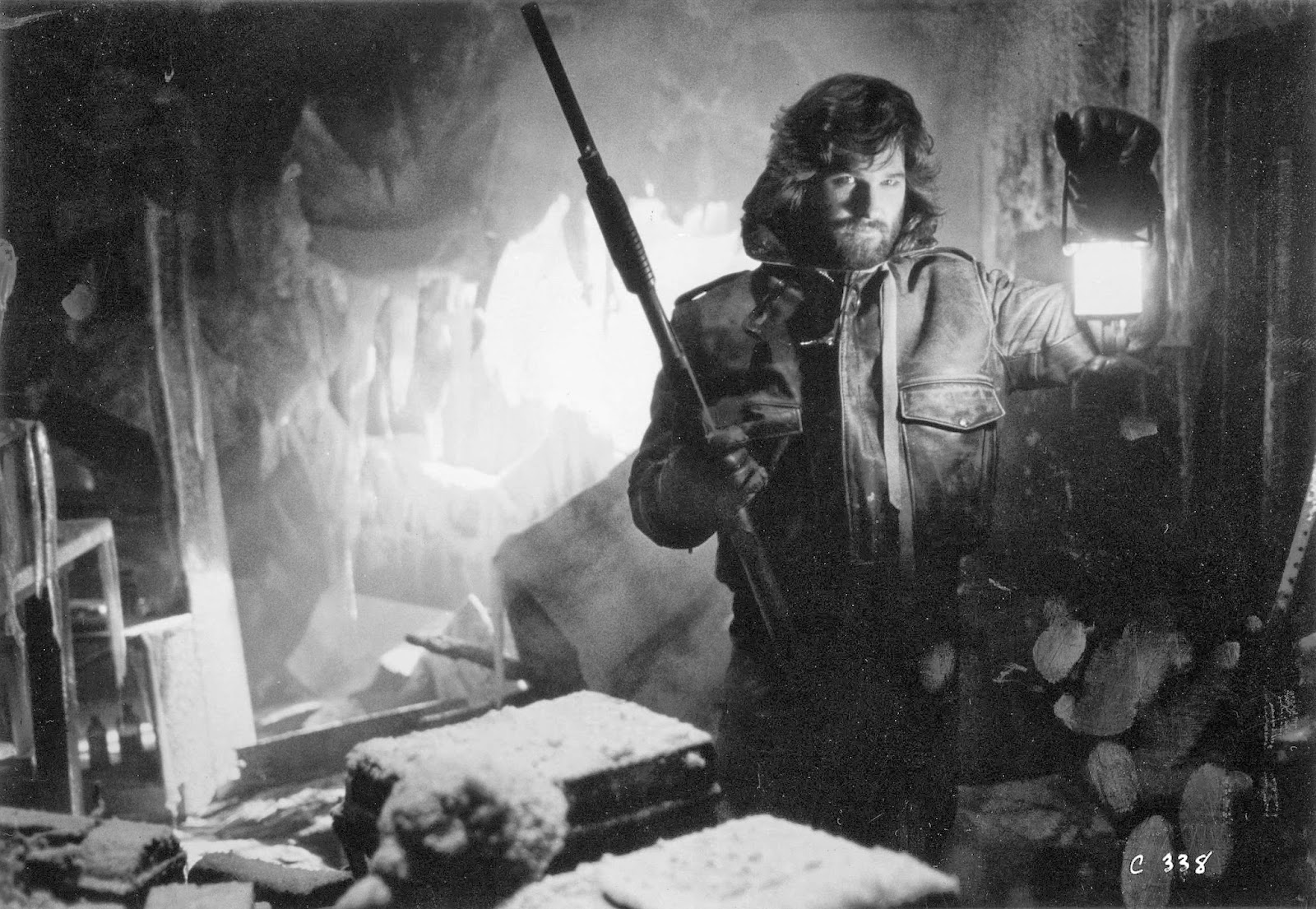 The only female in John Carpenter's The Thing isn't human. It is a digital voice issuing from a computer game and its purpose is to inform MacReady (Kurt Russell) that he has lost. In response to defeat, MacReady destroys the machine. Yet what follows for MacReady is a much larger and more complex game of strategy. MacReady is in a world of men. It is a small world, isolated and remote- it is located in a scientific research facility in the frozen Antarctic. The work these men do isn't really expanded upon because the focus shifts pretty rapidly to a dangerous and invisible threat that they become contaminated with after exploring a nearby base.
This film, like most action movies, is concerned with a battle amongst Alpha males. However, unlike most action movies, it is largely a battle of wits. Of course, there are explosions, and fist fights and shootings in keeping with all the action movie traditions. Nevertheless, the tension in this movie is unlike that featured in other action films. The paranoia in this film is omnipresent, it is almost a living thing and it it is far more unsettling then the alien which is hunting, or rather, residing inside some of these men. The remote nature of the base heightens it as does the close quarters and the relentless cold and snow. In many ways, the events of this film seem to be occurring on another planet. It is an alien world, in which an actual alien is attacking humans, but the behaviors of the humans within it are rather typical.
Though much was made of this film's groundbreaking special effects in the early 80s, its strength lies in its subtlety. It is the fear these men experience and the uncertainty over who is and isn't the enemy that makes this film. Unlike other action films, all male bodies are covered by heavy winter clothing. Of course, this is a necessity due to the frigid temperatures, yet this concealment adds to the sense of dread and paranoia. It reflects the hidden nature of the threat and the way in which each character has no way of knowing the true nature of the other. That these men are fully clothed also confirms that this film is a matter of brains over brawn. If they are to be victorious over the alien, they must use their intellect rather than brute strength.
Once the action begins, there are no longer any daylight scenes. All is dark and cold. This intensifies the sense of mystery and the unknown. Furthermore, The Thing's brilliant conclusion leaves the viewer with a sense of uncertainty. The final sequence of this film is wonderfully understated. Childs and MacReady are the only men left. They contemplate their situation in a conversation that is as subtle as the scene itself. There is, however, a danger beneath it- a veiled threat. The camera alternates the close up shots of their faces and the back and forth volley of their conversation reemphasizes the male competition theme of this film. It is unclear whether Childs is really human at this point (though there are some signs that he may not be). MacReady watches him and Childs glares back as the haunting soundtrack begins quietly. This scene solidifies the unsettled feeling that has been evident throughout the film and that feeling persists long after the film is over.
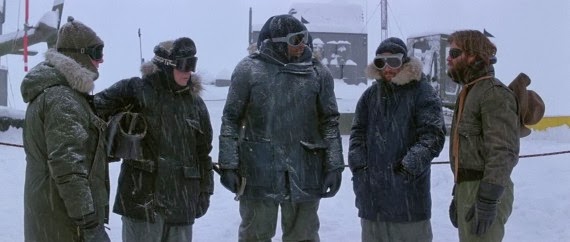 The original 1951 version of The Thing and the dreadful 2011 remake all featured a female character in the cast. I suspect this is the reason neither film is as effective as the 1982 version. The presence of a woman changes the entire dynamic of a situation. Doubtless, sexual tension increases and male competition becomes largely about impressing or protecting the woman (regardless of how tough and resourceful she proves to be). And also how revolutionary to eliminate female characters? For what is an action hero without at least one woman to bring the sex and the tits and the mussed up hair? (Although Kurt Russell's hair is looking pretty amazing in this film.) I can't think of a modern action movie with a cast of all men. Men are usually the major players in action films but there's always a girl or two in a movie to nag or cajole or flirt or just hang around looking hot and vulnerable (or as in the case of the 21st century film, a woman to play the action hero too). The Thing doesn't allow the viewer that comfort and it is weirder and scarier for it. There is no nurturing, maternal presence here. There is only a monster and a group of men fighting it and each other. By placing the characters in an environment that is sterile, that is a purely male situation, a specific dynamic is created. The conflict becomes about territory and self-protection. Alpha masculinity is distilled to its most ancient as a kind of primal survival instinct comes into play. As a result, this film is not just about a battle with an alien, but is ultimately concerned with the endless competition among men for primacy and dominance.
Thursday, January 23, 2014
Glitz, Glamour and the Glorification of Violence in 80s Film
 |
| The endless fight scene in Lethal Weapon |
This is not to suggest that all 70s action films were noble attempts to attack the violent behaviors of humanity. They weren't. They were, however, more responsible in presentation. The fight scenes and gunfights in the 70s film appear to be almost normal. They occur without fuss or fanfare and therefore have an un-elevated status. The 80s film becomes an expression of hyper-masculinity and along with this exaggerated maleness are sequences of over-the-top violent masculine activity. Moreover, many 80s films use music to heighten the exhilarating aspects of the many violent scenes. The violence, then, becomes a source of arousal and excitement in these films.
While the editing in the 80s film is much more careful, the fight scene itself is longer. The conclusion of nearly every 80s action film is a drawn out display of hyper violence. The confrontation between the good guy and bad guy is accented with dramatic music, flashing lights, driving rainstorms or occurs in an obviously male oriented place such as a warehouse. Moreover, though the characters throughout these films have always used weapons (whether guns, knives or explosive devices) in their confrontations, the concluding fight scene almost always involves fists- the combat must be physical, intimate. In some ways, the action is almost sexual, the previous violence a kind of foreplay and the conclusion the sex scene. That many action films are devoid of sex sequences is telling-- the violence becomes the only physical expression of sexual tension. Further, the visual and musical dramatics of the scene only accentuate this aspect of these films.
Sunday, November 24, 2013
Film and Dynamic Masculinity
In a previous post, I discussed concrete ideals of masculinity that were derived from biology and social constructs. I thought, however, that a good approach might be to think about archetypal masculinity. Or rather, certain ideals that connect to a sort of essential and natural masculine. Gareth Hill writes in his book, Masculine and Feminine: The Natural Flow of Opposites in the Psyche about the differences between the static and the dynamic masculine. This book tends toward a psychological analysis of masculinity, nevertheless it is interesting and it also can be applicable to action film. So here are some of the the buzzwords Hill attaches to the Dynamic and Static Masculine:
Dynamic:
Initiative
Goal Direction
Grandiosity
Linearity
Technology
Heroism
Static:
Order
Rules and Regulations
Systems of Meaning
Hierarchies of Value
Theories of Truth
Standards
Kingship, Knighthood
Persona
In a lot of ways it seems the action hero falls under the Dynamic masculine and yet there is a kind of underlying acknowledgement of the static, in that the hero is working to maintain or restore "order, truth, meaning, values" etc. Or rather, most films start with the protagonist utilizing the dynamic masculine and concluding in a static masculine state once that battle has been fought, the woman rescued and order restored. The source of these ideals is what is so compelling. Again, there is the question of a socially constructed ideal versus one that is biological. Perhaps there is a merging of both. This is a topic worth examining at greater length and with certain action films.
Source:
Hill, Gareth: Masculine and Feminine: The Natural Flow of Opposites in the Psyche
Dynamic:
Initiative
Goal Direction
Grandiosity
Linearity
Technology
Heroism
Static:
Order
Rules and Regulations
Systems of Meaning
Hierarchies of Value
Theories of Truth
Standards
Kingship, Knighthood
Persona
In a lot of ways it seems the action hero falls under the Dynamic masculine and yet there is a kind of underlying acknowledgement of the static, in that the hero is working to maintain or restore "order, truth, meaning, values" etc. Or rather, most films start with the protagonist utilizing the dynamic masculine and concluding in a static masculine state once that battle has been fought, the woman rescued and order restored. The source of these ideals is what is so compelling. Again, there is the question of a socially constructed ideal versus one that is biological. Perhaps there is a merging of both. This is a topic worth examining at greater length and with certain action films.
Source:
Hill, Gareth: Masculine and Feminine: The Natural Flow of Opposites in the Psyche
Thursday, November 14, 2013
Film and Physicality
 |
| A silly and entertaining fight scene from They Live. |
Certainly the bodies in action films do both. They propel the narrative by going out and seeking confrontations or responding in kind to the aggression of other male bodies. There is also the unstated limits of male activity in action film. By and large, men in these films are not going to display weakness or emotion. Many sociobiologists "[theorize] that men's bodies are the bearers of a natural masculinity produced by the evolutionary pressures that have borne down upon the human stock. [That] masculine genes [lend] tendencies to aggression, competitiveness, political power, hierarchy, territoriality, promiscuity and forming men's clubs." Further, "masculine gender is a certain feel to the skin, certain muscular shapes and tensions, certain postures and ways of moving, certain possibilities in sex."
Indeed roughness and muscularity, 'aggression', 'competitiveness' and 'territoriality' are major players in action films. According to Connell, men have a kind of physical status which they use to assert domination, yet this physical status is primarily learned and that men would be better suited to jettison antiquated notions of masculinity as being a purely bodily or aggression based state. Except masculinity cannot primarily be a social construct. Without it, there would be no historical narrative, or social constructs, for that matter. Certain stereotypically masculine traits like logic, reason and spatial acuity were necessary in the building of cities and societies. This isn't to suggest that women cannot possess any of these traits, but rather that historically men have had the opportunity to display them more readily. This, in itself, is problematic and returns to the question of men's physical status. Natural male dominance certainly prevented female advancement. More importantly, learned, imposed or inherent female passivity played a role in men becoming a dominant historical force.
It is likely that it isn't possible to separate masculinity from the male body. There are defining physical characteristics which in turn effect mental characteristics, personality and behavior. The action film showcases these in a manner that, to Connell, would be problematic. This masculinity, exaggerated though it may be, has a historical precedence. It cannot be ignored or simply relinquished as this behavior would be in opposition to thousands of years of learned or inherent masculine activity.
Source:
Connell, R.W. Masculinities.
Tuesday, November 12, 2013
The Running Man and The Necessity of Heroism
 The Running Man is a 1987 film directed by Paul Michael Glaser and starring Arnold Schwarzenegger. It takes place in L.A. in a dystopian future in which there is a police state; there is no art or music and money is banned. There are food and water shortages and the only source of pleasure is TV. All information that is produced for and shown on television has largely been altered in some way. The most popular game show is called The Running Man. Criminals are the contestants and the object of the game is that they must navigate a labyrinthine underground rink where they must fight to the death against Stalkers whose sole purpose is to hunt and kill them. The audience gets to select the Stalker they would prefer to kill the contestant in a formula that is rather like a grim American Idol.
This film is a convincing indictment of the vapidity of celebrity culture at the same time that it is an awesomely enjoyable action film. Schwarzenegger plays Ben Richards, a military man who refuses to carry out an order that would kill civilians. As a result of a cover-up and altered videotape, Richards becomes first a prisoner and then later a contestant on the show. Many of the conventions of a Schwarzenegger film abound; he carries large metal pipes on his shoulders and rips up furniture and items that are bolted down with ease. There is a woman named Amber Mendez (Maria Conchita Alonso) who he, first, in his desperation, kidnaps and then later, of course, protects. She, along with William Laughlin (Yaphet Kotto) and Harold Weiss (Marvin McIntyre), the two men whom Richards broke out of prison with, become contestants on the show after their capture.
This movie is concerned with futuristic criminal justice. The game is like a trial and the audience is the jury and freedom is the reward for those contestants who complete the game successfully. The contestants even have a "court appointed theatrical agent." Yet it is the Stalkers who are the most important. There is Subzero (Professor Toru Tanaka), Buzzsaw (Gus Rethwisch), Dynamo (Erland van Lidth), Fireball (Jim Brown) and Captain Freedom (Jesse Ventura). They have and use all sorts of weapons, like chainsaws, razor sharp hockey sticks, flame throwers, and electricity to defeat the contestants. The Stalkers are major celebrities and the fans of the show throw themselves at them and place bets on their performance.
The host of the Running Man is Damon Killian (Richard Dawkins). It must be said that Dawkins was made for this role, given his years of game show hosting experience. He clearly has a sense of humor about the nature of his work because he is pitch perfect as the villainous and slimy Killian. There is also an awareness of the general gawdy pomp of game shows. The Running Man features glitzy dancers that are reminiscent of the early 80s dance show, Solid Gold. The blending of bad choreography and violence is seamless and awful. More importantly, the audience is portrayed as just as awful as the dancers and host in that they are shown nearly ecstatic over the violence and mayhem featured on the show. They cheer when contestants are murdered as they perceive this as the deserved punishment for the criminals. At the same time, they seem to be unaware of the savage and awful nature of their behavior. More importantly, they are unaware that many of the images on the game show have been altered to suit its narrative.
Schwarzenegger's Richards, then, is the necessary replacement for the pseudo-heroics of the Stalkers. In each scenario with each Stalker, Richard's defeats them with ease. They are no competition for him, especially when he divests them of their weapons. The audience is against Richards until they witness the cowardly nature of Dynamo. Without his electrical weaponry he is reduced to sniveling and whining, shouting, "Cut to commercial! I don't have any power!" Richards spares him and the audience begins placing bets on Richards to win. There's only one Stalker who is serious about the game and that is Captain Freedom (which has to be the most American stage name ever). Jesse Ventura is at his over the top best in this role. Captain Freedom is retired and works as the show's commentator. He's so muscular, he looks peculiar in the white turtleneck and blue blazer host's uniform. It is odd to see Ventura not baring his muscles, but in a way he does bare them as he appears to burst out of his clothing in the same way that he delivers his rapid fire manic lines. Anyway, Captain Freedom is enraged when Killian decides to digitally alter the conclusion of the game by making it appear that Captain Freedom came out of retirement to fight and ultimately defeat Richards. He insists that he will fight him in real life, shouting that The Running Man is a "sport of death and honor."
Honor is the key point here. The major premise of the film isn't necessarily that media corrupts and controls the populace (although that is indeed a minor premise) but rather that people are desperate for heroes and celebrities and athletes often play that role. When Richards defeats the Stalkers, destroys Killian and clears his name, he becomes the hero. The audience celebrates and chants his name. Nothing in their horrible existence has been altered by Richards' victory but the suggestion is that it might be, now that justice and honor and truth have prevailed. Furthermore, Richards is so courageous that his bravery seems to rub off on people. Amber, who begin the game cowardly and fearful, ends up displaying a great deal of courage and also plays a pivotal role in allowing the truth about the game show to be revealed.
This is also one of the few Schwarzenegger films in which there is the suggestion that one of his characters is actually a sexual being. To start, he spends much of the movie in a form fitting, futuristic yellow and grey catsuit. In a strange way, the uniform hides his physique. He seems smaller and streamlined. Though in the earlier part of the film, his massive body was on display. Despite Schwarzenegger's almost feminizing attire during the latter half of the film, the sexual tension between Amber and Ben is obvious. It comes to a head in a scene near the conclusion, when Ben suggestively asks Amber where she hid the tape that held the true footage concerning Ben's military experiences. Later, when they are victorious, Ben sweeps her in his arms and they embrace passionately. In this way, The Running Man presents an entirely new version of Schwarzeneggerian heroics while upholding the standards of previous films.
Subscribe to:
Posts (Atom)