Showing posts with label masculinity. Show all posts

Monday, March 31, 2014

The Male Appetite

Appetite can represent the sexual realm or any manner of desire. Or it can simply refer to the prosaic activity of stuffing one's face, refueling for the next challenge. Many action film's feature a scene or two of the hero eating. Even this action must include some kind of reassertion or confirmation of his masculinity. Meat is the meal of choice, and sausage-y meals seem to win the day. Meat is bolted, eaten one handedly which is why hot dogs are the usual selection. It is often simply crammed into a corner of the mouth and chewed briefly while the hero stands and discusses his next plan. If he is seated to dine, he leans back or forward, taking up space, opening his lower body. Large quantities of food may also be eaten.

Arnold eating meat and making a goofy face.
Masculinity has been linked to meat eating since forever. There might be something to this as studies have shown that meat consumption increases testosterone levels. In the natural world, the predators eat meat. The prey forage for roots and vegetables and then usually get eaten by the predator while standing in a field or savannah somewhere staring into space and chewing. In the movie Predator, Arnold ate nothing. He rarely eats in his movies which is rather interesting as he seems to be above the baser appetites in his films. This might be an attempt to show strength of character (to match his physical strength) through abstaining. He does eat in Twins but that film is comedic and not action oriented at all so it doesn't really count. He is shown enjoying an ice cream cone with his daughter in Commando, but that scene is part of a montage used to reveal his devotion as a father. Once the action starts in that film, the food eating stops. In Conan, Arnold eats, drinks and notably, screws. But that was one of his earliest films, once he was established as action star, he abandoned decadent behavior and never fucked again (in movies anyway).


Testosterone aside, there is just something masculine about meat in itself. Sometimes it's skewered on a stick and roasted. Barbecue is usually performed solely by men. Even the name 'pit master' suggests something dominant or puts one in the mind of scenes from Conan the Barbarian. Compare carnivorous men to herbivorous men and it becomes obvious. Complete masculine failure is evident in the vegan man. They're typically emaciated and weak. They can barely speak above a whisper because they lack the energy. They are ghostly, undefined. They possess an air of sanctimonious vegan piety as they eat their pathetic meat substitutes. Food becomes all and the sex drive collapses. Much of vegan fare is estrogenic it must be noted, which explains the utter lack of masculine aggression most vegan men display.

Action heroes are never vegans obviously so we can be done discussing them. Yet in some films, they display some unusual eating habits. In Cobra, Sylvester Stallone is something of a picky eater, a rarity for an action star. He worries about his partner's sugar consumption and suggests he eat fruit (which is rather a feminine food). He is weirded out when Ingrid (Brigitte Nielsen) drowns her fries in ketchup.
Cobra appears to be a deep thinker, he mulls over the world while he chews his toothpick- that seems to be his sustenance. His first name is Marion though so maybe that's why he is so sensitive. The only time he is shown eating is in the opening of the film. He cuts cold leftover pizza with scissors (a masculine and resourceful solution to a lack of proper cutlery...having said supplies would be feminine, no?) and eats absentmindedly while watching the news and getting upset over the state of the world. But then this action becomes meaningless when he doesn't even eat the whole slice, only a dainty corner that he eats slowly, meditatively.

Tough guy seeks sustenance.
In The Thing, MacReady's so tough he eats whiskey. In Lethal Weapon, Riggs (Mel Gibson) inhales a hot dog at the side of the road. In Lethal Weapon II, Murtaugh (Danny Glover) and Riggs eat fast food with Leo (Joe Pesci) who gets stuck with a tuna sandwich he didn't order. Riggs and Murtaugh dine on more masculine meaty fare while Leo refuses to eat the tuna. The Dirty Harry films, too, are filled with hot dog eating. In Sudden Impact, Harry Callahan offers disgusted advice on the proper way to eat a hotdog to his partner: "nobody, I mean, nobody puts ketchup on a hot dog." In the first film in the iconic series, Dirty Harry stops a group of bank robbers by himself while casually chewing on the last bite of a hot dog. Said diner hot dog, we are told, is his typical lunch and dinner fare.


So why all this hot dog consumption? What is so masculine about the hot dog? The suggestive way it can be tucked into a bun? Is it its portability, it's phallic shape? Is it the insouciance and bravery that must belong to the hot dog eater, who is content, nay, eats with relish (heh) a tube of meat in a questionable casing fashioned from the flesh of various animals? Why do action heroes like hot dogs?


This is Part I of a four part series. Stay tuned for The Male Appetite Part II: Sex, The Male Appetite Part III: Altered States and The Male Appetite Part IV: Accessories and Acquisitions

Thursday, January 23, 2014

Glitz, Glamour and the Glorification of Violence in 80s Film

The endless fight scene in Lethal Weapon
The 70s film maintained a grim realism and an unflinching view of violence. Contradictorily, the imagery in these movies was often ugly, the fight sequences clumsy and the blood and gore was often an obvious technicolor fakery that was nevertheless gruesome and also, oddly, real. The 80s film used advances in special effects to make violent sequences hyper-realistic, well-choreographed and also strangely glamourous. Villains are thrown through windows in an explosion of sparkling glass, the texture and color of the blood is much more accurate and gun fights and fist fights are edited to heighten dramatic tension. In these films, violence becomes a kind of stylistic choice rather than necessary to the narrative. In this way, the 80s film ceases to critique violence and instead celebrates or even fetishizes it.

This is not to suggest that all 70s action films were noble attempts to attack the violent behaviors of humanity. They weren't. They were, however, more responsible in presentation. The fight scenes and gunfights in the 70s film appear to be almost normal. They occur without fuss or fanfare and therefore have an un-elevated status. The 80s film becomes an expression of hyper-masculinity and along with this exaggerated maleness are sequences of over-the-top violent masculine activity. Moreover, many 80s films use music to heighten the exhilarating aspects of the many violent scenes. The violence, then, becomes a source of arousal and excitement in these films.

While the editing in the 80s film is much more careful, the fight scene itself is longer. The conclusion of nearly every 80s action film is a drawn out display of hyper violence. The confrontation between the good guy and bad guy is accented with dramatic music, flashing lights, driving rainstorms or occurs in an obviously male oriented place such as a warehouse. Moreover, though the characters throughout these films have always used weapons (whether guns, knives or explosive devices) in their confrontations, the concluding fight scene almost always involves fists- the combat must be physical, intimate. In some ways, the action is almost sexual, the previous violence a kind of foreplay and the conclusion the sex scene. That many action films are devoid of sex sequences is telling-- the violence becomes the only physical expression of sexual tension. Further, the visual and musical dramatics of the scene only accentuate this aspect of these films.

Thursday, November 14, 2013

Film and Physicality

A silly and entertaining fight scene from They Live.
Movies would be unwatchable if nothing happened in them. So, as a rule, a film requires action; even if it isn't an action film, tension and conflict are necessary aspects. In the case of the action film, conflict is the main theme. Action movie conflict consists not of arguments but actual physical confrontation. Sequences such as these require plenty of images of the male body in action. These displays of masculinity are reflective of a certain idealized maleness that has held sway throughout the ages. Theorist R.W. Connell suggests that "mass culture generally assumes there is a fixed, true masculinity beneath the ebb and flow of daily life--[there is talk of] 'real men', the 'natural man', the 'deep masculine." This embedded masculinity "is almost always thought to proceed from men's bodies... either the body drives and directs action or [it] sets limits to action."

Certainly the bodies in action films do both. They propel the narrative by going out and seeking confrontations or responding in kind to the aggression of other male bodies. There is also the unstated limits of male activity in action film. By and large, men in these films are not going to display weakness or emotion. Many sociobiologists "[theorize] that men's bodies are the bearers of a natural masculinity produced by the evolutionary pressures that have borne down upon the human stock. [That] masculine genes [lend] tendencies to aggression, competitiveness, political power, hierarchy, territoriality, promiscuity and forming men's clubs." Further, "masculine gender is a certain feel to the skin, certain muscular shapes and tensions, certain postures and ways of moving, certain possibilities in sex."

Indeed roughness and muscularity, 'aggression', 'competitiveness' and 'territoriality' are major players in action films. According to Connell, men have a kind of physical status which they use to assert domination, yet this physical status is primarily learned and that men would be better suited to jettison antiquated notions of masculinity as being a purely bodily or aggression based state. Except masculinity cannot primarily be a social construct. Without it, there would be no historical narrative, or social constructs, for that matter. Certain stereotypically masculine traits like logic, reason and spatial acuity were necessary in the building of cities and societies. This isn't to suggest that women cannot possess any of these traits, but rather that historically men have had the opportunity to display them more readily. This, in itself, is problematic and returns to the question of men's physical status. Natural male dominance certainly prevented female advancement. More importantly, learned, imposed or inherent female passivity played a role in men becoming a dominant historical force.

It is likely that it isn't possible to separate masculinity from the male body. There are defining physical characteristics which in turn effect mental characteristics, personality and behavior. The action film showcases these in a manner that, to Connell, would be problematic. This masculinity, exaggerated though it may be, has a historical precedence. It cannot be ignored or simply relinquished as this behavior would be in opposition to thousands of years of learned or inherent masculine activity.

Source:
Connell, R.W. Masculinities. 

Monday, November 4, 2013

Commando: Schwarzenegger as Heroic Nurturer/Killing Machine

Since I've mentioned Commando in previous posts I feel it is necessary to give it its own write up. In part, because Commando is an incredibly masculine movie and is in keeping with the theme of this blog, but really, I am writing about it because it is awesome. This movie is beyond the beyond- there are heaving muscles, slimy bad guys- including one who is perpetually ensconced in a chain mail tee-shirt, there's Dan Hedaya playing a South American dictator...warlord...who knows?, and, of course, there's Arnold Schwarzenegger destroying shopping malls, blowing up things and killing people in new and exciting ways in an attempt to retrieve his kidnapped daughter, Jenny (Alyssa Milano). This movie has it all. Also, it has some very pointed messages on the meaning of manhood in a specific time and place.

Vernon Wells, punk rock warlord?
That time and place is the 1980s and Commando is an unbelievably 80s film. Arnold Schwarzenegger plays John Matrix, a devoted single father who happens to be a retired Black ops Commando, hence the title of the film. He's an unstoppable killing machine who also manages to be a protector, nurturer and a kind of universal father figure to all females he encounters. This incongruity is evidenced in the opening sequence of the film, which shows Schwarzenegger doing burly, manly things like cutting down trees and then juxtaposes that with images of him and his daughter petting and feeding a faun or sitting at the table sharing a meal. This is to make clear that when things go wrong, Matrix will be tough or tender depending on the situation. And since this is an action movie, things go wrong pretty quickly. Once Jenny is kidnapped by Arius and his crew, Matrix goes wild. He jumps out of plane without a parachute, he kills with his bare hands (all while maintaining a sense of humor).

When he enlists the help of Cindy (Rae Dawn Chong), a flight attendant, the nurturing nature of Matrix is evident. At first, she is terrified of him, but later she realizes that his intensity is only due to his desperation to retrieve his daughter. There is no sexual tension between Cindy and Matrix because Matrix is, of course, concerned only with finding Jenny. Yet he also is seemingly above sex. Matrix is the ultimate good guy. Though he may sometimes employ violent means, he only does so to rescue those in trouble. Matrix is masculine from a purely powerful and courageous standpoint. That he is presented as uninterested in sex further reveals his heroic nature. In many ways, Matrix is a modern day iteration of a knight.  Consider that "knighthood is a series of masculine performances,--saving ladies in distress, wearing armor, fighting with a lance" and it seems clear that Matrix is operating in a knight-like way. He takes on the role as a kind of guide and protector, even teaching Cindy to fly a plane. He is wholly good, whereas the bad guys in this film are thoroughly and irretrievably evil.

Speaking of bad guys, I'd like to focus a bit on Arius, Bennett and Cooke (Bill Duke). I've written about Sully (David Patrick Kelly) already so I think I'll leave him out of this one. Bennett is the metal mesh (armor worn by a corrupt knight, perhaps) vest wearer. He is a killing machine too, but he operates on the wrong side. Arius calls all the shots, while using a remarkably bad and very comical pseudo South American accent, while Bennett carries them out. They are the complete opposite of Matrix and they seem to thrive on being villains. Again, their presence in the film is uncomplicated. They are the enemy, the one the viewer is waiting for Matrix to come and destroy. As is common in films of this genre, they have no redeeming qualities. When Matrix does arrive, he kills them in the most over-the-top fashion imaginable. Arius, the leader, is lucky in that his death is pretty easy. He is simply shot by Matrix and then falls dramatically off a building. For Bennett, it is murder by metal pipe (lance). Matrix is so strong he rips a pipe from a wall and impales Bennett with it. It is impossible to ignore the sexual implications of this moment. Of course, Matrix eliminates any tension with a one-liner. Impalement seems to be the method of choice for Matrix, as he also uses it to kill Cooke-- punching him so hard he flies into the air and lands on the jutting points of broken wooden furniture. The asexual Matrix seems to get off using large phallus shaped objects to kill people.

The impalement imagery is interesting. The scenes in which the impalements occur are obviously throughly violent. They seem to be deliberately presented as a means for Matrix to channel his sexual energies. This is odd considering that Commando is clearly a film about protective masculinity. It's almost difficult to reconcile the contradictions running rampant through this film. However, the strange blend of incredible violence and nurturing in this film is curious, compelling and most importantly, endlessly entertaining.

Source:
Reeser, Todd. W. Masculinities in Theory

Tuesday, October 22, 2013

The Limitations of Maleness

It is almost impossible to write about masculinity. It isn't done. Many would say that masculinity has been written about since the beginning of human existence. That all stories have largely been written by men, about men and their exploits. This perception seems erroneous, or, at the very least, lazy. Certainly, men have been the dominant force throughout history, but it might be wrong to assume that dominance is without its drawbacks.  Dominance, in itself,  might be limiting.  Consider the "paradox of masculinity-- that it is often perceived to be free, unlike femininity and its imagined constraints. [However, this] is an illusion of freedom, the illusion that masculinity itself can be defined as freedom, whereas in fact it is this very imagined freedom that insures subjugation and hides its own arbitrary functioning."

Really, there are only a few ways to be a man, or there are only a few ways to represent masculinity in the proper way. If anything, the action and crime film reveals this very limited spectrum of acceptable maleness. The violence inherent in them could be representative of a pushing against this construct (since there isn't anything else for men to do, why not take it as far as possible?) or it might simply be that scenes of explosions and car chases and fist fights are entertaining and make good movies. (And they do.) However, it's interesting that women always complain about how their gender are portrayed in movies as weak and one-dimensional, but men are often shown as strong and one-dimensional. The 70s film allowed men a little more depth, but by the 80s most men were flexing their muscles suggestively for the camera. When gender theorist Todd Reeser writes about masculinity, he insists that,"masculinity might be in crisis when many men in a given context feel tension with larger ideologies that dominate or begin to dominate that context." He suggests that "feminism in the 70s and 80s precipitated a crisis of masculinity."

He might be on to something. It could explain the way 80s film became so much about a pumped up masculinity. Certainly, by this time women were really invading the working world in numbers never before seen. A way to respond to this invasion would be by emphasizing physical difference via becoming an enormous, muscle bound man. Yet the action star of the 80s, in some ways, seems less masculine because of this behavior.  He's certainly far less complicated than the 70s star. He parades around in his form fitting clothes so that the world can see his physique. Sure, he's got guns, and knives and rocket launchers, but everything is about his body.  And everything is about the body with men. Men's brains are important, of course, but emphasis has always been placed on being big and strong. More importantly, male roles are concerned with providing and protecting-either their women, or their family or their country. Indeed, there is little that men can call their own if one eliminates all the responsibilities attendant in manhood.

Many of the films of these eras attempted to examine these responsibilities. In the next few posts, I will review some of the war films of 70s and 80s and see how masculinity is portrayed in them.


Source:
Reeser, Todd W. Masculinities in Theory

Thursday, October 10, 2013

Gazing at Big Men: Objectification in the 80s

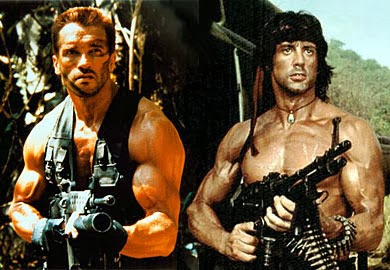
The most striking change in the films of the 1980s versus the 1970s was not the wardrobe of the actors/characters, but rather their physical appearance. As if to mirror the excesses of the decade, the 80s action star was swollen, buff, massive, almost cartoonish in appearance. In films such as Predator, Commando and Rambo the camera lingers over the muscular physiques of Schwarzenegger and Stallone. The camera objectifies, regardless of whether the subject is male or female, though much has been made of female objectification in film. The difference, here, is the way men on screen get to perform their objectification.  Critic Laura Mulvey refers to a kind of "looking [that is located] solely in relation to activity/passivity," specifically, that men "look" and women are the "object of the look." This is largely true and is a legacy of the patriarchy and certainly film has been a reflection of that, but an examination of any action film of the 80s turns that point upside down.

This, too, is what makes these films so unique. While they are performing and upholding a conservative Reagan era agenda, they also seem to be playing with these ideals, poking fun at them. Schwarzenegger, despite his Austrian origin, is American might writ large. In Commando, he carries trees that he felled himself on his shoulder like a modern day Paul Bunyan; later he rips seats out of cars, phone booths out of walls. In Predator, he wins a punching match with a seven foot alien.  This sort of strength is ridiculous, it's impossible. Attached to this strength is a kind of joviality. Schwarzenegger never loses his sense of humor, even when he kills. This seems in some way to be an intentional or unintentional jab at American wholesomeness--the American belief in the over-arching goodness in all that is American, no matter what is done in the name of patriotism and to whom.

More importantly, there is something almost silly about the kind of hyper-masculinity displayed in these films, and, I'd argue, these movies are, to use a Terminator 2 term, "self-aware" of their over-the-top aspects. Manliness is being celebrated in these films, but it is also being fetishized. These bodies are being used, to beat and bludgeon, yes, but they are still performing objects. Critic Steve Neale focuses on this idea in his essay "Masculinity as Spectacle: Reflections on Men in Mainstream Cinema," he asserts that these films treat "images of men" in three ways, by "identification, voyeuristic looking and fetishistic looking." Furthermore, he perceives that there are "erotic elements involved in the relations between the spectator and the male image [that must] be constantly...repressed and disavowed...[else] mainstream cinema would have to openly come to terms with male homosexuality." With this last point, I disagree. I think that the 80s film is so concerned with showcasing the right (in the conservative sense) kind of masculinity that the point is that the male viewer is to watch and admire these bodies and to aspire to become strong and brave in the same way. The characters are presented as courageous and tough- they are the ideal male.  In most of these films, they are so busy killing there is no time for sex. If anything, they seem asexual. This isn't to deny that some viewers may watch and get aroused by the characters, but that isn't the point. The bodies on display in the films are for use solely for their strength; they are essentially big machines.

These are purely physical beings, not mental. They don't have rich interior lives- they act, they react and that's it. This seems to be very similar to the way in which women are objectified--except these male bodies are used for strength, not sex and while they aren't always portrayed as particularly bright, they are still powerful.

Sources:
Mulvey, Laura. (1975). "Visual Pleasure and Narrative Cinema" & "Afterthoughts...Inspired by Duel in the Sun." (1981).

Neale, Steve.  "Masculinity as Spectacle."

Saturday, September 14, 2013

The Films of the 70s and 80s

Here is the moment in which I set down the actual theme of this blog. It appears that I am as focused as I am ever going to get, so, the focus, then, of this blog, will be gender and film. Specifically, the ways in which masculinity is presented in film. The best place to start, to me anyway, is through the action adventure and crime films of the 70s and 80s. The 70s film featured a kind of strong, silent masculinity. Men in these films were either buttoned up and suave or sort of rumpled. No matter how neat or sloppy they were, the typical wardrobe choice was a suit or slacks. Toughness was not overt, but rather, suggested. When violence occurs it isn't necessarily surprising but it isn't the theatrical well-choreographed violence of the 80s. The 70s fight sequence seemed way more believable than the 80s fight scene. The 70s character could be wounded and never springs up from a punch to the face or a kick to the groin as if nothing happened. In the 80s film, the action heroes are seemingly invincible. This is evident in their appearance.

Actors such as Arnold Schwarzenegger and Sylvester Stallone's bodies are on display. They glisten with sweat, muscles and veins jump out constantly. They rarely wear suits as in them their huge physiques would look ridiculous. They wear jeans (tight ones, too) and sleeveless shirts, or very often, no shirt at all. Even the least steroidal of the 80s action stars, such as Mel Gibson, display their bodies. In all the Lethal Weapon films, Sgt Riggs' very fitted faded denim jeans and cowboy boots get much attention from the camera and he also takes an opportunity to flex his biceps.


The point is that a very rapid evolution occurred between these two eras. The action star transformed from moody, cerebral and hard in mind, if rather lumpy in body, to a man that was tough externally, clearly not a deep thinker, (save for a few tortured characters---I'm thinking Gibson's grieving Riggs in Lethal Weapon) who took blows and seemed to get stronger from them. In the 80s, strength becomes a purely physical thing. Soundness of body is paramount. A theory that I have concerning this change is that it is largely political. Many of the 80s action films have a very obvious conservative agenda. I aim to make a comparison of a number of films from both eras and examine what was occurring during these times that might have led to these changes.